

In a landscape dominated by rigid tokenomics and outdated inflation models, HYDRA breaks new ground with the first data-driven, market-aware economic system in blockchain.
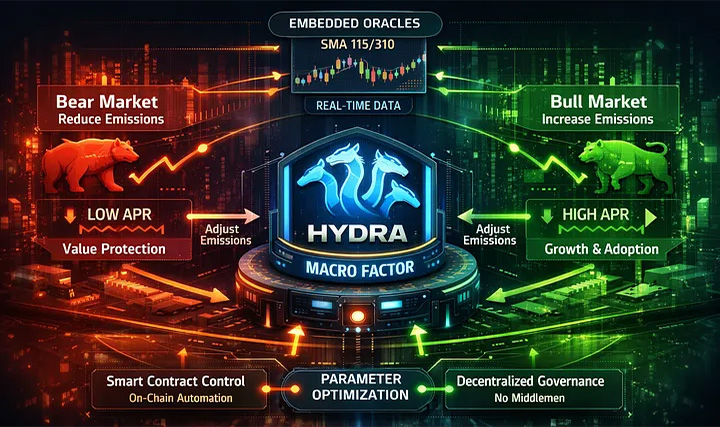
At its core is a dynamic emissions model governed not by fixed schedules, but by real-time market data. Hydra nodes double as embedded oracles, using a backtested SMA crossover system {115/310} to track $HYDRA price behavior and feed this data into a smart contract–driven Macro Factor. This multiplier dynamically adjusts staking emissions, increasing them in favorable conditions and reducing them during downturns — mirroring the adaptive logic of real-world economies.
Unlike static chains that inflate blindly through bear markets, HYDRA intelligently contracts its emissions to preserve value and incentivize loyalty. And when sentiment turns bullish, the system boosts emissions to accelerate adoption and liquidity — all without human intervention.
This mechanism wasn’t guesswork — it emerged from over 10,000 parameter tests, selecting a model that outperforms static inflation schedules over time. The result is a self-regulating ecosystem that not only protects users from downside volatility, but positions HYDRA as a long-term competitor to assets like Bitcoin in terms of cyclical strength and adaptability.
Most importantly, all of this runs on-chain, through fully transparent smart contracts built into the consensus layer — no off-chain governance, no centralized switches.
For investors and builders alike, Hydra offers something unprecedented: a blockchain that thinks with the market. Its algorithmic halving mechanism is a leap beyond time-based emissions, actively optimizing for stability and growth — and delivering a new paradigm in crypto economic design.
Explore more at hydrachain.org