


Onchain DEX data has become essential for developers, traders, and analysts navigating the rapidly expanding decentralized finance ecosystem. Whether you're building a portfolio tracker, developing trading algorithms, or analyzing market trends, the quality and comprehensiveness of your onchain DEX data API directly determines the reliability of your applications and insights.
In this guide, we'll evaluate the leading onchain DEX data APIs in 2026, comparing their coverage, data delivery methods, latency, historical depth, and pricing to help you choose the right solution for your specific needs.
Understanding Onchain DEX Data APIs
Onchain DEX data APIs provide programmatic access to decentralized exchange (DEX) data directly from blockchain networks. Unlike centralized exchanges where a single operator broadcasts prices, DEXs operate as open-state machines on public ledgers where price is derived from token reserve ratios in smart contracts.
There are two categories of onchain DEX data APIs. Exchange-specific APIs are provided by individual DEXs like Uniswap or PancakeSwap through their own GraphQL endpoints or node queries. Aggregated APIs consolidate data from multiple DEXs, networks, and liquidity pools into a unified interface.
This guide focuses on comparing aggregated providers. For most projects, an aggregated approach offers significant advantages as the DeFi ecosystem continues to expand. The infrastructure costs and technical complexity of integrating data sources individually is simply not scalable for teams whose primary focus is not data infrastructure.
Evaluation Criteria: How to Choose the Best Onchain DEX Data API
Understanding key differentiators helps you evaluate which solution fits your requirements.
Market and Asset Coverage
Coverage determines how much of the onchain market you can analyze. Evaluate token counts, DEX support, liquidity pools, and blockchain networks. Long-tail coverage ensures you can display prices for any token, regardless of market cap.
Data Endpoints and Delivery Methods
Consider endpoint variety and delivery methods. REST APIs offer universal compatibility. WebSocket connections enable real-time streaming. GraphQL interfaces allow precise data requests and complex queries.
Latency and Data Freshness
For portfolio trackers, 10 to 30 second refresh intervals suffice. For trading applications, sub-second latency via WebSocket streaming becomes critical. Understand whether providers offer true real-time data or cached responses.
Historical Data Availability
Historical depth determines backtesting capabilities. Data from 2020 or 2021 enables analysis across multiple DeFi market cycles. Granularity options range from daily aggregates suitable for trend analysis, to minutely or even 1-second intervals for detailed strategy testing. Some providers also offer tick-level historical trade data, capturing every individual swap for market microstructure research.
Pricing Structure
Pricing models vary from straightforward call credits to consumption-based systems where query complexity affects cost. Evaluate transparency, hidden costs, and whether meaningful free tiers exist for testing.
Top 5 Best Onchain DEX Data APIs
Based on coverage, data quality, pricing, and developer experience, here are the top onchain DEX data APIs available in 2026.
CoinGecko API: Best All-Around Choice for Comprehensive Coverage and Reliability

The CoinGecko API is the most comprehensive and reliable onchain DEX data source available today. Through its GeckoTerminal integration, CoinGecko provides unmatched breadth across tokens, networks, and exchanges. Its data is trusted by major platforms including MetaMask, Phantom, Magic Eden, Etherscan, and Statista, and is the most widely used onchain market data API in the industry.
Key Features
- Asset coverage: Widest in the industry with 24 million+ DEX tokens from 1,700+ exchanges across 250+ networks. Coverage includes both verified assets and long-tail tokens.
- Data variety: Over 20+ REST endpoints covering tokens, OHLCV data, recent trades, top traders, trending and new pools. The Megafilter endpoint enables advanced multi-chain pool searches with 25+ filtering options. Also provides exclusive data including token security metrics such as honeypot detection, community scores, and the proprietary GT Score trust rating, plus 120+ onchain categories that group tokens by themes, brands, or events for enhanced discovery.
- Data freshness: True real-time (cache-less) data for key endpoints including Token Price by Token Addresses, Past 24 Hour Trades by Pool Address, and Past 24 Hour Trades by Token Address. Other endpoints cache at 10-second intervals.
- Historical depth: Onchain DEX data available from 2021 with granularity as fine as 1 second, plus minutely, hourly, and daily intervals. Recent trade endpoints return up to 300 trades per pool or token.
- Enterprise reliability: 99.9% uptime SLA and SOC-2 Type 2 certification for production-grade applications.
Pricing
- Demo {Free}: 10,000 calls/month, 30 calls/min, 6 months onchain historical data
- Basic {$35/mo}: 100,000 calls/month, 250 calls/min, 6 months onchain historical data
- Analyst, Lite, Pro {from $129/mo}: From 500,000 calls/month, 500 calls/min, full onchain historical data from 2021
- Enterprise {Custom}: Custom limits with 99.9% uptime SLA guarantee
Pros
- Widest asset coverage across tokens, networks, and exchanges, including tracking of long-tail tokens
- True real-time {cache-less} data on selected endpoints with WebSocket streaming available starting from the Analyst plan
- Full historical access from 2021 at $129/mo, making it highly cost-effective for comprehensive onchain data
Cons
- Recent trade endpoints limited to the latest 300 trades per token or pool
- WebSocket access requires Analyst plan {$129/mo} or higher
Best For: Most developers, researchers, and businesses that need comprehensive onchain DEX data with the widest coverage across networks, tokens, and exchanges. Ideal for portfolio trackers, analytics dashboards, and applications requiring reliable, normalized data. Explore all endpoints in the CoinGecko API Documentation.
CoinMarketCap API: Established Provider with REST-Only Access
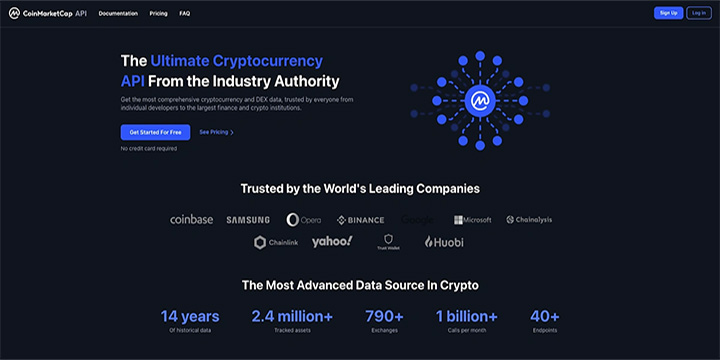
CoinMarketCap {CMC} offers an onchain DEX API its DexScan product. While it provides solid coverage and integrates seamlessly with CMC's broader market data platform, its approach to historical data access and data delivery methods creates friction for developers requiring real-time capabilities or deep historical analysis.
Key Features
- Asset coverage: 2.4 million+ DEX tokens across 350+ DEXs on 120+ blockchain networks.
- Endpoint variety: 20+ REST endpoints including trending tokens, batch queries, candlesticks, K-line data, pool details, liquidity queries, and swap lists.
- Data freshness: Endpoints refresh at varying intervals. Token and pool data updates every 10 seconds, K-line and candle data every 15 seconds, and spot pairs and trending data every 30 seconds.
Pricing
- Basic {Free}: 10,000 call credits/month, 30 calls/min, No historical data
- Hobbyist, Startup, Standard, Professional {from $35/mo}: From 110,000 calls/month, 30 calls/min, 1 month historical data
- Enterprise {Custom}: Custom limits and full historical data from 2020
Pros
- Strong brand recognition backed by Binance
- Seamless integration for teams already using CoinMarketCap's ecosystem
- Good endpoint variety covering common DEX data use cases
Cons
- No WebSocket available for onchain data, limiting real-time streaming capabilities
- No historical data on the free plan, and full historical access requires Enterprise pricing
Best For: Teams already integrated with CoinMarketCap's Pro API who need DEX data within the same ecosystem and can accept REST-only access without real-time streaming requirements.
Bitquery API: Best for Advanced Analytics and Custom Queries

Bitquery represents a fundamental departure from the aggregator model, positioning itself as an infrastructure indexer rather than a data aggregator. Using GraphQL, it exposes raw blockchain state data, enabling complex analytical queries that would not be possible with standard REST APIs.
Key Features
- Asset coverage: Over 1 million+ tokens across 40+ blockchains and 100+ DEXs.
- Flexible GraphQL interface: Enables custom queries to retrieve trades, OHLC data, volume, liquidity events, token holders, and mempool transactions. Users can define custom aggregation intervals and request precisely the fields they need.
- Data freshness: 1-second granularity via WebSocket (GraphQL Subscriptions) or Kafka. Mempool data access enables viewing transactions before block confirmation.
Pricing
- Developer {Free}: 10,000 points, 10 rows per request, 10 requests/minute, 2 testing WebSocket streams
- Commercial: Contact sales for custom pricing and limits based on usage
Pros
- Flexible GraphQL interface allows arbitrarily complex queries across multiple data dimensions
- Real-time streaming with mempool access for advanced trading applications
- Deep historical data extending to blockchain genesis, valuable for forensic analysis and research
Cons
- Significant learning curve and implementation time due to GraphQL complexity and blockchain-specific data models
- No transparent mid-tier pricing between free and enterprise, requiring contacting sales to scale usage beyond the free tier
Best For: Institutional traders, and developers who need highly customizable queries, mempool access, and cross-chain analytics. Best suited for teams with blockchain engineering expertise who can navigate GraphQL complexity.
DexScreener API: Free Option for Live Data Only

DexScreener has established itself as a popular retail-focused platform with a free API designed primarily to support its core discovery functionality. While acceptable for real-time pair tracking, its limitations make it unsuitable for applications requiring historical analysis or high-volume usage.
Key Features
- Asset coverage: Over 2 million+ tokens across 300+ DEXs on 80+ blockchain networks.
- Data variety: 10+ REST endpoints focused on live data including token profiles, boosted tokens, pairs by address, pool searches, and community takeover tracking.
- Data freshness: 1-second indexing of new liquidity pools after pool creation.
Pricing
- Free: No API key required, rate limits of 60 requests/minute for token profile endpoints and 300 requests/minute for pair and pool endpoints
Pros
- Completely free with no API key required, making it highly accessible for quick integrations
- Suitable for discovering new pairs and tokens after launch
- Generous rate limits for real-time onchain data polling
Cons
- No historical OHLCV data available through the API
- Limited endpoint variety focused only on live data without rich metadata or analytics
- No pagination support and hard rate limit ceiling with no paid tier to scale beyond limits
Best For: Hobbyists and developers needing quick, free access to live DEX pair data for discovery purposes. Not suitable for applications requiring historical analysis, backtesting, or production-scale data volumes.
DexPaprika API: Event-Driven {SSE} Onchain Data Streaming

DexPaprika, developed by the CoinPaprika team, offers a free API with a streaming capability through Server-Sent Events (SSE). With more limited coverage compared to leading providers, it serves as a straightforward option for developers seeking basic onchain data access with real-time updates.
Key Features
- Asset coverage: Over 500,000 tokens across 350+ DEXs on 30+ blockchain networks.
- Data variety: 10+ REST endpoints covering token data, top pools, batched prices, OHLCV data, and pool transaction history.
- Streaming capability: SSE endpoint for event-driven real-time updates, simpler to implement than WebSocket connections.
Pricing
- Free: 10,000 calls/day, 10 calls/second, historical data access from 2024
- Pro API {Enterprise}: Contact Sales for higher API limits
Pros
- Generous free tier with 10,000 daily requests
- SSE streaming provides real-time updates with simpler implementation than WebSockets
- Historical OHLCV data with multiple interval options up to minutely granularity
Cons
- Lower token coverage of 500,000+ compared to millions available from leading providers
- Limited network coverage of 30+ chains compared to competitors with 100+ to 250+ networks
- Historical data only extends to 2024, missing years of onchain activity for backtesting
- Limited endpoint variety focused on basic price and pool data, lacking advanced features such as token security metrics, category-based discovery, or traders analytics
Best For: Developers seeking a free API for onchain data across a modest set of chains, with basic historical OHLCV requirements and no need for deep historical analysis.
Comparing The Best Onchain DEX Data APIs
| Provider | Asset Coverage | Data Endpoints | Data Freshness/Latency | Historical Data Availability | WebSocket Availability | Starting Price |
|---|---|---|---|---|---|---|
| CoinGecko | 24M+ tokens 1.7K+ DEXs 250+ networks |
20+ | Real-time (cache-less) on selected endpoints; 10-second cache on others | From 2021 | Yes | $35/mo |
| CoinMarketCap | 2.4M+ tokens 350+ DEXs 120+ networks |
20+ | 10-30 second cache | From 2020 (Enterprise-only) |
No | $35/mo |
| Bitquery | 1M+ tokens 100+ DEXs 40+ networks |
GraphQL (flexible) | 1-second via streaming | From Genesis block | Yes | Enterprise |
| DexScreener | 2M+ tokens 300+ DEXs 80+ networks |
10+ | 1-second updates | Not available | No | Free plan only |
| DexPaprika | 500K+ tokens 350+ DEXs 30+ networks |
10+ | 10-second cache | From 2024 | Yes (SSE) | Enterprise |
Verdict: For most developers and businesses requiring onchain DEX data, CoinGecko API offers the strongest combination of coverage, historical depth, and value. Its 24 million+ tokens across 250+ networks represents the widest coverage available, while its Analyst plan ($129/mo) unlocks full historical data, WebSocket streaming, and real-time, cache-less endpoints at an accessible price point. For developers specifically seeking direct blockchain data access with raw transaction-level queries and mempool visibility, Bitquery provides powerful GraphQL-based infrastructure suited for advanced analytical use cases.
Decision Framework: Which Onchain DEX Data API Should You Choose?
Use this framework to match your use case with the right provider.
Building a Portfolio Tracker or Wallet Application
Choose CoinGecko API for its unmatched asset coverage across 24 million+ tokens and 250+ networks, ensuring metadata, logos, and pricing for any token a user might hold. CoinGecko’s batch endpoint capabilities also make updating entire portfolios efficient.
Developing a Token Discovery Dashboard
Choose CoinGecko API for its speed and coverage. New pools are indexed rapidly via GeckoTerminal, while the Megafilter endpoint enables cross-network discovery with 25+ filtering parameters and 120+ onchain categories to surface tokens by theme or trend.
Backtesting Trading Strategies Across Market Cycles
Choose CoinGecko API for historical depth back to 2021 with 1-second granularity, enabling comprehensive backtesting across multiple DeFi market cycles. For raw trade data with custom aggregation periods, Bitquery provides deeper analytical capabilities.
Building High-Frequency Trading or Arbitrage Systems
Choose Bitquery for mempool access and sub-second streaming via WebSocket subscriptions. CoinGecko API serves as an alternative with real-time WebSocket streams for prices and trades, though without mempool access.
Building Onchain Security and Forensic Analysis Tools
Choose Bitquery for raw blockchain data with transaction-level detail extending to genesis blocks. CoinGecko API complements this with security-focused data including honeypot detection, GT Score trust ratings, and community sentiment metrics.
Building Enterprise or Institutional-Grade Applications
Choose CoinGecko API for its SOC-2 Type 2 certification, 99.9% uptime SLA, and dedicated enterprise infrastructure that accommodate high-volume institutional workloads with audit-ready security practices.
Operating on a Tight Budget or Building a Personal Project
Choose CoinGecko API's free Demo plan for its 10,000 monthly calls, 6 months of historical data, and the widest coverage of 24 million+ tokens across 250+ networks, making it the best free onchain DEX market data API. DexScreener also offers free access without an API key, though without historical data.
Conclusion
Choosing the right onchain DEX data API depends on your specific requirements. Coverage, latency needs, historical depth, and budget all play a role.
For the majority of developers and businesses, CoinGecko API stands out as the top choice. Its unmatched coverage of 24 million+ tokens across 250+ networks, historical depth back to 2021, low-latency endpoints, and transparent pricing with a genuinely useful free tier makes it the most versatile and accessible option available. For Enterprise use-cases, CoinGecko API’s SOC-2 Type 2 certification and 99.9% uptime SLA ensures high reliability.
Ready to start building? Get your CoinGecko API key today and power your applications with the most comprehensive onchain DEX market data provider.
Original source of this article: CoinGecko.