

Welcome back to our series breaking down complex crypto topics. We’ve explored the blockchain ledger, the Proof-of-Stake engine, and the smart contracts that run on it. Now, let’s dive into the single biggest application built with that technology: Decentralized Finance (DeFi).
At its core, DeFi aims to rebuild the entire traditional financial system — lending, borrowing, trading, earning interest — but without the need for central authorities like banks. Instead of relying on a corporation to process your loan or execute your trade, you rely on transparent, open-source smart contracts. This creates a system that is more accessible, efficient, and open to everyone.
Imagine wanting to trade one asset for another. In traditional finance, you go through a centralized exchange. In DeFi, you use a Decentralized Exchange (DEX), which is a smart contract that holds liquidity and executes trades automatically based on code, not on a company’s order book. This is the promise of DeFi: a financial world run by auditable logic, available 24/7.
The Problems Plaguing DeFi on Legacy Chains
The vision of DeFi is powerful, but its execution on older, slower blockchains like Ethereum has often been frustrating. Users are frequently hit with three major problems:
- High & Volatile Gas Fees: When the network is busy, the cost to make a single trade can skyrocket to unreasonable levels, making DeFi impractical for average users.
- Slow Transactions: Trades can take minutes to confirm, leaving users in limbo and unable to react quickly to market changes.
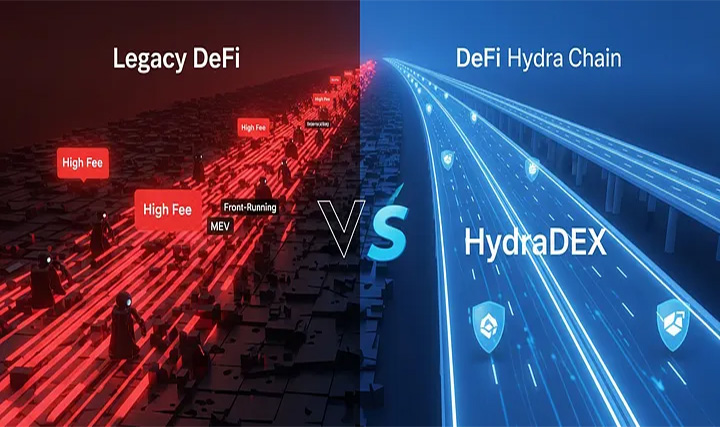
- Front-Running & MEV: On slow chains, sophisticated bots can see your pending transaction and jump the queue, buying an asset moments before you do, only to sell it back to you at a slightly higher price. This practice, known as MEV (Maximal Extractable Value), drains billions of dollars from ordinary users.
DeFi Without the Delays and Dangers: The Hydra Advantage
This is precisely where Hydra Chain’s superior architecture provides a fundamentally better DeFi experience. A prime example of this in action is the native DEX on Hydra, HydraDEX (hydradex.org) — check it out and see how lightning-fast DeFi feels in practice.
The platform leverages Hydra’s unique strengths to solve the core problems of DeFi:
- Instant Finality Defeats MEV: Hydra’s sub-second block times and instant finality mean there is no “pending” period for bots to exploit. When you send a transaction on HydraDEX, it’s confirmed almost instantly, making it virtually impossible for front-running bots to manipulate your trade. This creates a safer and fairer environment.
- Low, Stable Fees: Hydra’s efficiency ensures that transaction fees remain consistently low, allowing users to trade on HydraDEX without worrying about prohibitive costs.
- Enhanced Capital Efficiency: DEXs on Hydra, including HydraDEX, can implement advanced features like concentrated liquidity. This allows liquidity providers to earn far more fees on their capital, making their money work much harder for them.
By providing the core infrastructure to eliminate front-running, high fees, and slow speeds, Hydra Chain enables platforms like HydraDEX to deliver on the true promise of DeFi: a fast, fair, and efficient financial system for everyone.
In our final article, we’ll look beyond finance and explore the future of digital ownership with NFTs and the Metaverse.