

Welcome back to our series, Crypto Concepts Demystified. In our first article, we described a blockchain as a secure, shared digital notebook. But what keeps that notebook secure? What’s the engine that validates transactions and adds new “blocks” to the chain? The answer is the consensus mechanism — and the two most dominant types are Proof-of-Work (PoW) and Proof-of-Stake (PoS).
🔗 Proof-of-Work: The Original Powerhouse
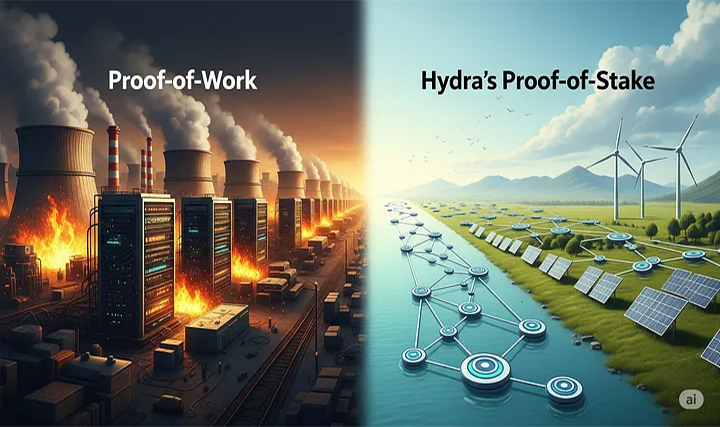
Proof-of-Work was the first consensus mechanism, pioneered by Bitcoin. You can think of it as a highly competitive race. Across the globe, powerful computers called “miners” compete to solve complex mathematical puzzles. The first miner to crack the code gets to add the next block of transactions to the blockchain — and earns newly minted coins as a reward.
This method is extremely secure. But its greatest strength is also its biggest drawback: the sheer amount of computational effort needed consumes vast amounts of electricity, raising significant environmental concerns.
🌱 Proof-of-Stake: A Greener, More Efficient Path
Recognizing PoW’s drawbacks, a new approach emerged: Proof-of-Stake. Instead of a race based on computing power, PoS works more like a lottery. To participate, users “stake” their own coins as collateral to become validators. The more coins you stake, the higher your chance of being randomly chosen to validate a new block and earn rewards.
This model is thousands of times more energy-efficient because it doesn’t rely on a constant computational arms race. That’s why many modern blockchains — including Hydra Chain — use Proof-of-Stake as their foundation. But Hydra doesn’t stop there.
⚖️ Smarter and Fairer: How Hydra Advances Proof-of-Stake
A common criticism of basic PoS systems is that they can drift toward centralization. If a few “whales” — individuals or pools with massive holdings — control most of the stake, they can wield outsized influence over the network.
Hydra Chain tackles this challenge head-on with a simple yet powerful tweak: an exponentiating staking formula.
In a typical PoS system, if you have 100 times more stake than someone else, you’d have 100 times more voting power. But on Hydra, the network applies a square root (^0.5) to delegated staking weight. So, if you have 100 times more stake, you only get 10 times the voting power (because √100 = 10).
This clever mathematical adjustment helps level the playing field. It limits the dominance of large pools, encourages wider validator participation, and strengthens the network’s decentralization and security.
•••
By choosing Proof-of-Stake, Hydra is already an energy-efficient platform. But by refining it with a fairer staking formula, Hydra ensures the network stays robust, secure, and governed by its community — not just its biggest holders.
Stay tuned for our next article, where we’ll explore what runs on top of this engine: The World of Smart Contracts.