

Welcome back to our series where we simplify the world of crypto. So far, we’ve learned that a blockchain is a secure digital ledger (link) and that a consensus mechanism like Proof-of-Stake is the engine that powers it (link). Now, let’s explore the software that runs on that engine: smart contracts.
🤖 What is a smart contract?
At its core, a smart contract is simply a program that runs on a blockchain. Think of it like a highly trustworthy digital vending machine. You insert a coin (input), and the machine automatically dispenses your chosen snack (output). There’s no need for a cashier; the rules are pre-programmed and automatically enforced.
A smart contract works the same way. It’s an “if-this-then-that” agreement written in code. “If you deposit 100 HYDRA into this contract, then it will send you 1 ‘AwesomeNFT’.” Once deployed on the blockchain, this code is immutable and unstoppable. It will execute exactly as written, every time, providing a level of transparency and predictability that traditional contracts can’t match. This powerful technology is the foundation for almost everything in crypto, from Decentralized Finance (DeFi) to NFTs.
⚙️ The EVM: The Standard for Smart Contracts
The concept of smart contracts was popularized by Ethereum. It created a standard environment for these programs to run in, called the Ethereum Virtual Machine (EVM). The EVM became the “operating system” for the decentralized world, and millions of developers learned its language (Solidity) and built tools for it. This created a massive, vibrant ecosystem. The challenge, however, has often been that the Ethereum network itself can be slow and expensive, creating bottlenecks for the very applications it hosts.
🚀 Hydra’s Key Advantage: Build Without Barriers
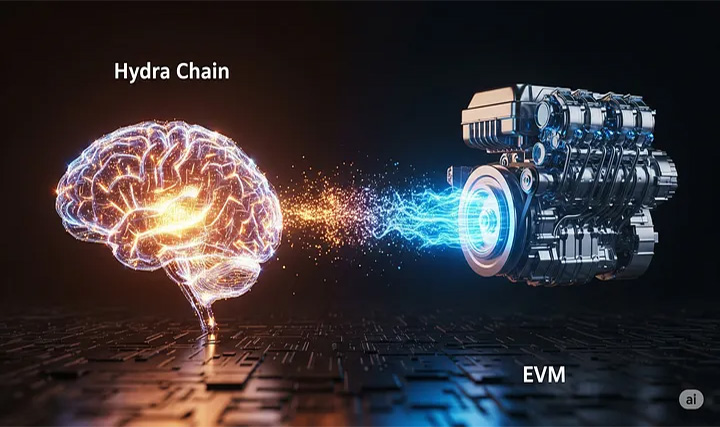
This is where Hydra Chain offers a game-changing advantage. Hydra is 100% EVM compatible.
This is incredibly significant. It means any smart contract, application, or tool built for Ethereum can run on Hydra without any changes. For developers, this removes all friction. They can take their existing code and deploy it directly onto Hydra’s faster, more efficient engine. There’s no new language to learn and no new tools to master. They gain an immediate performance upgrade — with instant transaction finality and ultra-low fees — without any extra work.
For users, this means a seamless experience. You can use the world’s most popular crypto wallet, MetaMask, to interact with a growing universe of powerful applications on Hydra, just as you would on Ethereum, but without the high costs and long waits.
By combining the established, universal standard of the EVM with its own next-generation blockchain architecture, Hydra offers the best of both worlds. It provides a faster, cheaper, and more reliable home for the thousands of applications that define the decentralized web.
In our next article, we will look at the single biggest use case for smart contracts: Decentralized Finance (DeFi) 💸