


In our first article in this liquidity series, we explored the idea of liquidity pools — the backbone of decentralized exchanges (DEXs). Now it’s time to move from theory to practice. This guide will show you how to make your first deposit on HydraDEX, turning your HYDRA assets from idle tokens into an active source of fees and rewards.
💡 Why Should You Provide Liquidity?
By becoming a Liquidity Provider (LP), you play an active role in Hydra’s DeFi ecosystem. When you provide liquidity to a pool, you help enable smooth, trustless swaps between tokens. In return, you can earn rewards from two sources:
✅ Trading Fees: You collect a share of the fees paid by traders who swap tokens in your pool.
✅ Liquidity Mining: For certain pools, you may also earn bonus token rewards as an extra incentive for locking up liquidity.
Combined, these rewards can turn your holdings into a powerful yield-generating tool — especially if you’re strategic about how you manage your position.
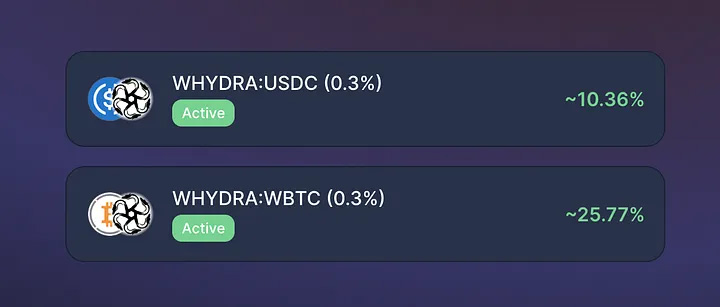
🗝️ Your Practical Step-by-Step: HydraDEX in Action
HydraDEX is designed to be as fast and efficient as possible, with Hydra’s ultra-low latency and sub-1 second finality giving it a serious advantage over other chains. Here’s what to do:
1️⃣ Connect Your Wallet
Open HydraDEX using your desktop browser or your mobile wallet’s dApp browser. Connect your wallet to get started.
2️⃣ Create a New Position
Click the Pools tab, then New Position. Select the pair of tokens you’d like to provide liquidity for — for example, HYDRA and USDC.
3️⃣ Choose a Fee Tier
Each position needs a fee tier. For example, 0.05% or 0.3% — this sets the fee that traders pay and that you earn. Different token pairs work best with different tiers. Keep an eye on pairs with active liquidity mining campaigns, too.
4️⃣ Set a Price Range
Here’s where Hydra’s modern design shines. Unlike old DEXs that use wide price ranges, HydraDEX supports concentrated liquidity, letting you specify the exact price range where your liquidity will be active. Narrower ranges mean your liquidity works harder — you earn a bigger share of the trading fees. But remember: if the market price moves outside your chosen range, you stop earning until it returns.
5️⃣ Deposit Your Tokens
Enter how much of each token you want to deposit. You’ll need to add equal value for each side of the pair — a 50/50 split in value.
6️⃣ Approve and Add Liquidity
First, you’ll “Approve” HydraDEX to access your tokens. Then, click Add. Your position will be confirmed in under a second thanks to Hydra’s sub-1s finality, which is faster than almost any L1 or L2. You’ll instantly receive an LP NFT, which acts as a digital receipt. This NFT includes your unique price range, fee tier, and liquidity details, so you can easily adjust or remove your position later.
⚠️ What About Risks? Understanding Impermanent Loss
Providing liquidity isn’t risk-free. The biggest risk is Impermanent Loss (IL) — the potential difference between the value of your tokens if you’d simply held them in your wallet, versus the value of your LP position when token prices change. But here’s the good news: fees and liquidity mining rewards can often offset, or even outpace, the impact of IL — especially for pairs with healthy volume and good price range selection.
🚀 Take the Next Step
Ready to go deeper? Check out the complete step-by-step walkthrough with screenshots in the HydraDEX Documentation. And remember: the HYDRA rewards you earn can be staked for even more yield — compounding your growth within the Hydra ecosystem.
This is just the beginning. In our next piece, we’ll unlock advanced strategies for Concentrated Liquidity, so you can fine-tune your price ranges like a pro and maximize your potential rewards.
Hydra makes your crypto work smarter — in record time.
Disclaimer: This content is for educational and entertainment purposes only. It does not constitute financial advice or an endorsement of any project. Always do your own research and assess risks before engaging with any platform.