


The strength, security, and decentralization of a Proof-of-Stake network are critically influenced by its validator set and the extent of community participation through staking. An analysis of #Hydra Chain’s validator data as of August 14, 2025, is particularly revealing when contextualized with the specifics of the Hydra ecosystem. With approximately 26,878,597 $HYDRA bridged to the new HydraGon chain (out of a total supply of 31,717,355 HYDRA and a circulating supply of 28,436,451 HYDRA), this sets the foundation for understanding its staking dynamics.
📊 Network Staking Engagement on Hydra
The staking figures for Hydra continue to highlight high levels of on-chain engagement:
- Total HYDRA Staked on the HydraGon chain: 17,713,613 HYDRA
- Total HYDRA Bridged to HydraGon: 26,878,597 HYDRA
- Circulating Supply: 28,436,451 HYDRA
- Total Supply: 31,717,355 HYDRA
HydraGon’s staking participation rates demonstrate strong investor commitment and systemic alignment:
- 65.94% of HYDRA bridged to HydraGon is staked
- 62.29% of circulating supply is staked
- 55.84% of total supply is staked
Breakdown of Staked HYDRA (on HydraGon):
- Self-Staked by Validators: 398,944 HYDRA
- Delegated to Validators: 17,314,669 HYDRA
Active Validators: 16
- Combined Voting Power: 15,239
Of all staking positions on HydraGon, approximately 35% are unvested, while 65% are vested. This mix highlights a high degree of long-term alignment by participants. Unvested positions remain relatively liquid (subject to a 7-day cooldown), while vested positions earn loyalty multipliers and reinforce long-term security. Notably, the 30-day systemic inflation remains at just 0.03%, ensuring minimal token dilution and sustainable economic pressure.
🧲 Stake Distribution and Influence
HydraGon’s supermajority consensus threshold of 61.4% of total voting power ensures strong resistance to collusion while maintaining fast, deterministic finality. The use of an exponentiating voting formula reduces the influence of large stakeholders and boosts smaller ones, promoting decentralization by design.

Largest Validator: 0xd99d…86294f9f
- Total Stake: 3,886,789 HYDRA (15,888 self + 3,870,901 delegated)
- Voting Power: 1,971 (12.93% of network total)
- Stake Share: ~21.94% of all staked HYDRA
Despite holding nearly 22% of stake, this validator’s voting power is algorithmically capped at 12.93%, reinforcing Hydra’s fairness-through-formula design.
Smallest Validator: 0x0975…9e81330c
- Total Stake: 43,585 HYDRA (40,398 self + 3,187 delegated)
- Voting Power: 208 (1.36%)
- Uptime: 7% — critically low, risking slashed rewards and lost trust
This validator still retains 1.36% of voting power — another real-world example of Hydra’s commitment to empowering small participants with meaningful influence.
💸 Commission Rates: Market Trends and Incentives
- Fee Range: 1% to 10%
- Most Common Rate: 1%
- Average Fee: 4.25%
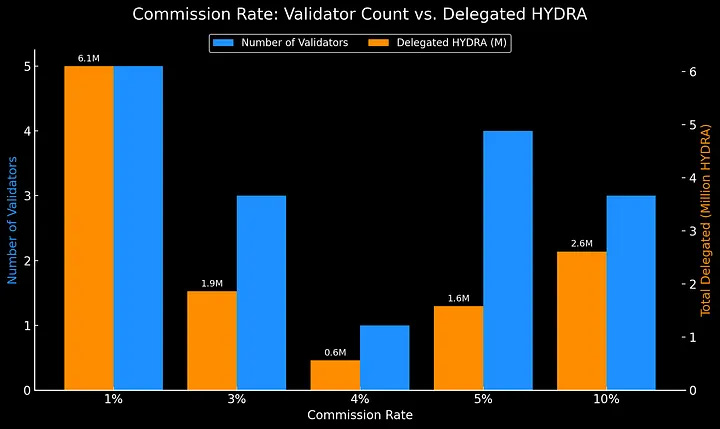
Validators charging 1% receive the lion’s share of delegation — collectively attracting over 6.1 million HYDRA. This indicates a strong preference among delegators for cost-efficiency. However, some high-fee validators (10%) still secure substantial delegations, suggesting social credibility or trust in performance play a role beyond fees.
⏱️ Uptime: A Core Metric for Reliability
- Average Validator Uptime: 94.19%
- 15 of 16 Validators: Report 100% uptime
- Lowest Performer: 0x0975…9e81330c (7%) — falling far short of reliability expectations
Validator uptime has direct impact on reward distribution and staking security. The near-perfect uptime of most validators demonstrates technical discipline across HydraGon’s network.
🌐 HydraGon vs Other Chains: A Comparative Edge
HydraGon’s validator economics present several advantages over major L1s:
- Cosmos chains like Juno or Osmosis have >100 validators, but suffer from power centralization and high inflation (8%+ annually)
- Solana runs thousands of validators, but voting power remains highly concentrated
- Ethereum requires 32 ETH per validator with uniform cap, limiting influence and flexibility
The new HydraGon chain strikes a rare balance: a lean validator set, ultra-low inflation, and algorithmic decentralization — without sacrificing accessibility or security.
🔚 Final Thoughts
HydraGon’s validator landscape reflects not just functional design but ideological alignment: incentivizing fairness, rewarding reliability, and enforcing decentralization. With over 65% of bridged HYDRA staked, a mathematically-enforced supermajority threshold, and a fine-tuned emissions model, HydraGon is setting a benchmark for how economic incentives can power sustainable and secure consensus in Proof-of-Stake networks.