

In our previous article, we explored how Bitcoin emerged in response to the failures of the traditional financial system. While revolutionary, Bitcoin had limitations: slow transactions, energy intensity, and limited scripting capabilities. These drawbacks opened the door to a new wave of innovation — the era of altcoins.
Altcoins, or “alternative coins,” are any cryptocurrencies that aren’t Bitcoin. The earliest altcoins, like Litecoin and Namecoin, aimed to tweak Bitcoin’s model — offering faster block times or different consensus mechanisms. But soon, entirely new blockchain visions took shape.
Ethereum, launched in 2015, marked a major turning point. It introduced a general-purpose smart contract platform, enabling developers to create decentralized applications (dApps) on-chain. With it came a surge of use cases — from decentralized finance (DeFi) and NFT platforms to DAOs and prediction markets.
Other chains followed, each carving out a niche. Monero focused on privacy. Chainlink provided off-chain data to smart contracts. Filecoin tackled decentralized storage. This specialization laid the foundation for a more modular and purpose-driven blockchain ecosystem.
⚙️ The Trade-offs of Specialization
But with specialization came trade-offs. Many altcoins offered niche benefits while sacrificing decentralization or compatibility. Others struggled to attract developer mindshare due to poor tooling or lack of network effect. Worse yet, many promised innovation but delivered little more than hype.
Ethereum and its EVM became the default standard, creating a fractured environment of EVM-compatible vs. non-compatible chains. Bridging between ecosystems added complexity, and new chains had to choose between building from scratch or inheriting Ethereum’s limitations.
🔷 Enter Hydra: Purpose-Driven Without the Pitfalls
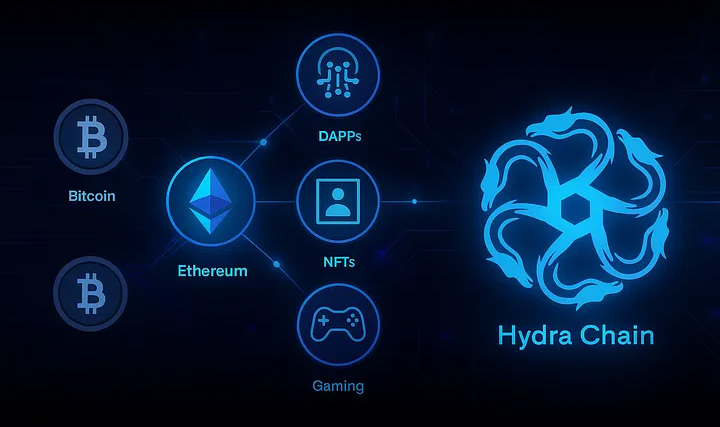
Hydra Chain recognizes the need for specialization — but without the usual trade-offs. It merges key innovations from past blockchains while solving the biggest frictions they faced.
Hydra offers:
- Flexible, EVM-native architecture, making it easy to deploy specialized dApps using industry-standard tools.
- Real-time performance with sub-second block times and instant finality — ideal for time-sensitive apps like gaming or trading.
- Support for micro-economies, thanks to ultra-low gas fees that enable real-time payments, in-app transactions, and streaming revenue models.
- Cross-ecosystem interoperability, allowing seamless integration with Ethereum-based projects and simplifying bridge deployment.
- Incentive-aligned governance, with exponentiated staking power and dynamic inflation/deflation that adapts to community and network behavior.
- Permissionless validator infrastructure, ensuring open participation while maintaining decentralization and resilience.
This gives builders the flexibility to specialize — without locking into slow, costly, or isolated systems. Whether for DeFi, NFTs, gaming, or custom dApps, Hydra provides the foundation needed to innovate.
Altcoins expanded the scope of what blockchains could do. Hydra refines it — offering a unified, efficient, and future-proof platform.
Next up: Stablecoins — Bridging the Gap Between Crypto and Fiat.