

The #blockchain space is locked in a race to solve the trilemma: scalability, security, and decentralization. Two projects tackling this from very different angles are #Hydra Chain and #Near Protocol. Both aim to create ecosystems capable of supporting mass adoption, but their design philosophies diverge sharply.
This article compares Hydra Chain’s HydraGon consensus and adaptive economic model with Near’s Nightshade sharding and fixed-inflation staking system — and explores what this means for developers, validators, and users.
🏛 Consensus & Core Architecture
- Hydra Chain (HydraGon)
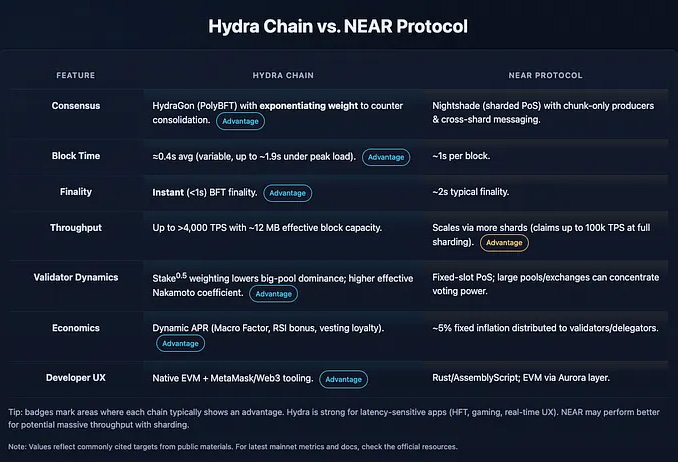
Hydra’s latest engine is built on PolyBFT, a Byzantine Fault Tolerant consensus that guarantees instant finality — once a transaction is included in a block, it cannot be reversed. HydraGon also achieves average 0.4 second block times.
Unlike many L1s, Hydra is designed to self-optimize: validator competition drives block times lower as hardware improves, allowing the network to get faster without disruptive upgrades.
- Near Protocol (Nightshade)
Near scales through sharding, splitting the blockchain into multiple parallel shards. Each shard processes its own set of transactions and communicates with others. While this enables high throughput, it comes at the cost of complexity. Finality on Near averages ~2 seconds, making it slower than Hydra’s design.
🚀 Scalability
- Hydra Chain uses a variable block time model, flexing between ~0.4s and ~1.9s depending on network load. Combined with a 12 MB block size, this enables throughput beyond 4,000 transactions per second (TPS).
- Near relies on adding shards as demand grows. While sharding scales linearly in theory, it introduces challenges: cross-shard communication delays, added developer complexity, and the need to optimize for multiple execution environments.
Hydra’s approach is simpler and more predictable for developers, while Near’s is ambitious but harder to execute at scale.
🔐 Decentralization & Validator Dynamics
- Hydra’s Exponentiating Formula Hydra introduces an industry-first consensus formula: validator weight is calculated as stake ^ 0.5. This reduces the dominance of large pools and boosts smaller validators. For example, a validator with 82% of stake is reduced to ~54.8% effective voting power, forcing collaboration with smaller peers.
This design dynamically increases Hydra’s Nakamoto Coefficient, meaning more validators are needed to compromise the system — a major improvement in decentralization.
- Near’s Validator Set Near uses a traditional proof-of-stake model with fixed validator slots and a minimum stake requirement (~15,000 NEAR). While relatively open, large staking pools and exchanges can still dominate, resulting in a Nakamoto coefficient of 7 (compared to Hydra’s 9, currently).
💰 Economics & Inflation
- Hydra’s Adaptive Model Hydra’s economic system is market-aware. Inflation adjusts based on: Macro Factor (market conditions) RSI Bonus (boosting APR when HYDRA is oversold) Vesting & Loyalty Rewards (higher APR for long-term staking)
This means APRs vary dynamically, encouraging staking during downturns and preventing runaway inflation during bull markets. Under normal conditions, systemic inflation averages around 6–7% annually.
- Near’s Fixed Inflation Near has a fixed inflation rate (~5% annually), distributed among validators and delegators. While predictable, it lacks Hydra’s responsiveness to real-time market dynamics.
👨💻 Developer Experience
- Hydra Chain Hydra is fully EVM-compatible. Developers can deploy Ethereum contracts directly with Metamask and standard tooling, without modification. This reduces friction for projects migrating from Ethereum or launching multi-chain applications.
- Near Protocol Near uses Rust and AssemblyScript for contracts. While powerful, it requires developers to learn a new stack. Near’s Aurora project provides an EVM bridge, but this adds another layer of complexity.
🎮 Real-World Applications
Hydra’s sub-second finality and predictable performance make it ideal for:
- High-frequency trading
- Real-time DeFi protocols
- Blockchain gaming (instant player actions without off-chain workarounds)
Near, with sharding, is better suited for large-scale dApps where throughput matters more than single-transaction latency, such as social platforms or enterprise use cases.
📊 Head-to-Head Summary
🏁 Conclusion
Hydra Chain and Near Protocol represent two very different bets on blockchain scalability. Near is building a sharded supercomputer, but with complexity that slows adoption. Hydra, by contrast, focuses on raw performance, adaptive economics, and simplicity for developers.
For builders seeking #Ethereum compatibility, instant finality, and true decentralization, Hydra Chain presents a compelling alternative to Near’s sharded model.